

Fall music activities can be a wonderful way to bring seasonal themes into music lessons while still keeping musical learning at the center.
Leaves are changing colors, falling, floating through the air, and moving with the wind. And all of those images can become wonderful starting points for exploring music with children.
But when I use a seasonal theme, I don’t want the theme to become more important than the musical learning itself.
Instead, I like to ask:
How can this theme help children experience a musical concept in a more meaningful way?
Fall leaves give us so many possibilities.
They can float and fall. They can move high and low. They can travel through space. And visually, they can even become notes on a music staff.
So in this post, I want to share a sequence of fall music activities that you can adapt to your own classroom, workshop, piano lesson, or small group setting.
We’ll begin with movement, continue with listening and melodic direction, and eventually bring our fall leaves onto the music staff.
The goal is to help children make connections between what they feel, what they hear, and what they see in music notation.
 “Save this idea for later
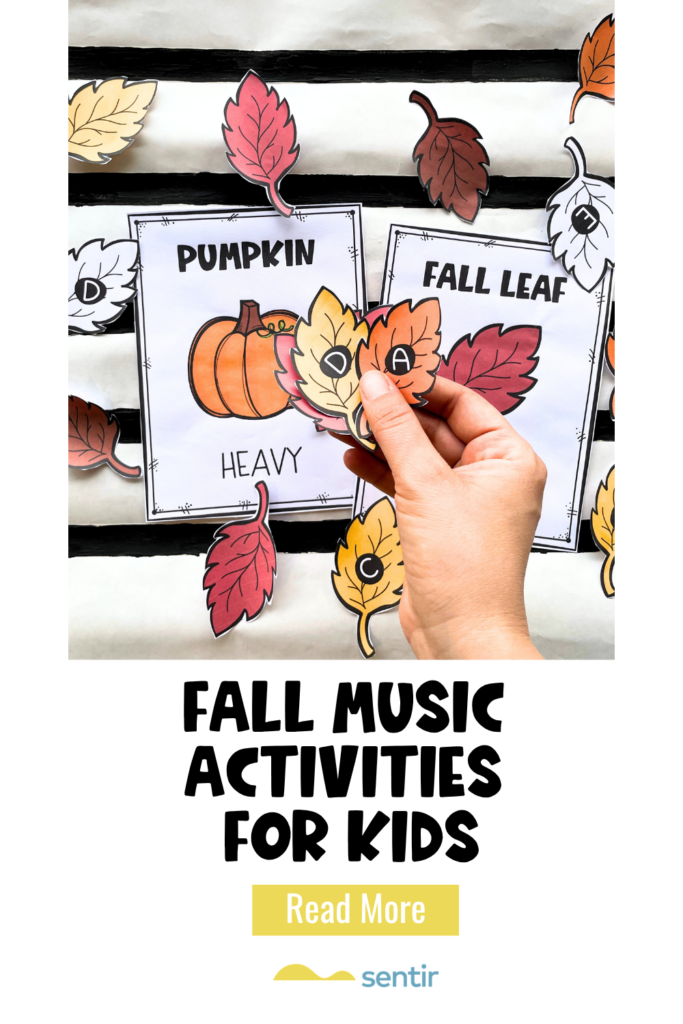
Why Start With Movement?
Before bringing out worksheets or even the music staff, I like the idea of beginning this fall sequence with the body.
Movement can give children an opportunity to experience musical qualities before we ask them to identify or represent them visually.
This idea also connects with an important part of my own musical training.
In approaches influenced by Music Learning Theory, movement plays an important role in helping children experience music. The movement activities suggested by Edwin Gordon draw from Rudolf Laban’s exploration of four elements of movement: flow, weight, space, and time.
Rather than trying to explore everything at once, we can focus on just one quality and experience its contrasts.
For a fall-themed lesson, flow and weight give us a wonderful place to start.
1. Explore Flowing Movement Like the Fall Wind
Choose a piece of music that works well for your students.
I intentionally wouldn’t recommend one specific song here.
Every group is different, and I think teachers should feel free to choose music that fits their students, teaching style, repertoire, and lesson goals. You might choose something that feels autumnal, but it doesn’t necessarily need to be a song specifically about fall.
Begin by exploring flowing movement.
Encourage students to move their arms, shoulders, hands, and eventually their whole bodies using large, continuous movements.
You can introduce an image:
Imagine the wind moving through the trees.
Can your movement continue without stopping?
Can it curve?
Can it travel around your body?
Can your whole body become part of the movement?
At this point, we aren’t trying to create a specific choreography.
We’re simply exploring how movement feels.
Within the movement approach described in Music Learning Theory, fluency or flow is considered a foundational element before other qualities such as weight, space, and time are emphasized.
And fall gives us a beautiful visual way to experience it.
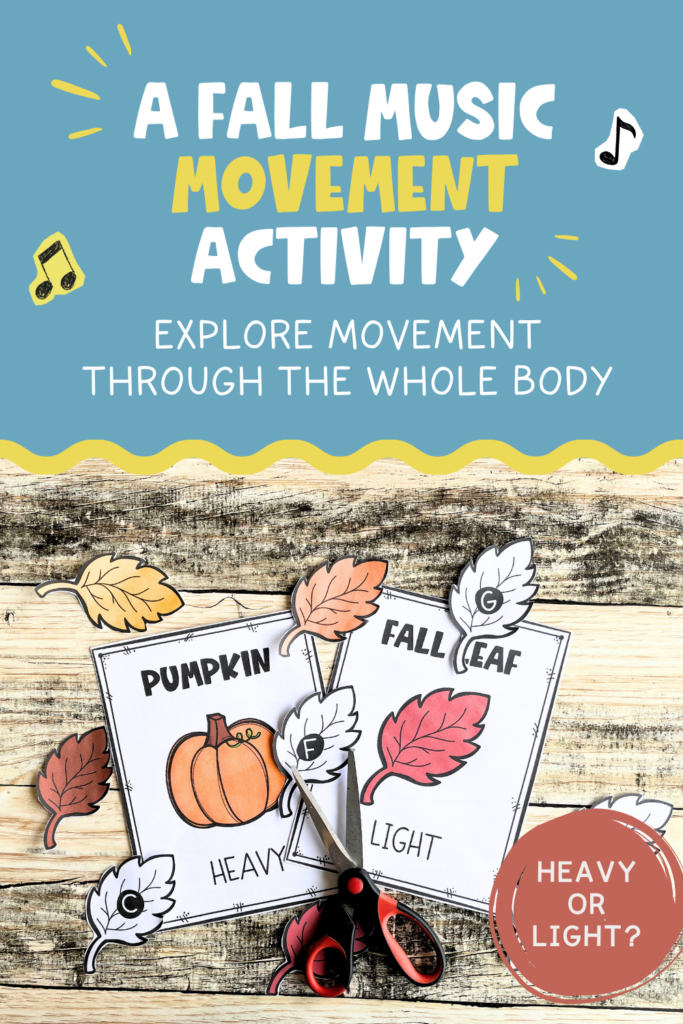
2. Explore Heavy and Light Movement
Now we can introduce one of my favorite contrasts for this activity:
heavy and light.
First, ask students to imagine that their bodies are incredibly heavy.
They might become rocks.
How would a rock move?
How does your body feel when your movements have a sense of weight?
Explore that sensation for a moment.
Then completely change the image.
Now you’re a fall leaf.
Suddenly the body becomes light.
A leaf can float.
It can be carried by the wind.
It can slowly travel toward the ground.
It might even rise again when another gust of wind appears.
Let students experience the difference between those two sensations:
Rock → Heavy
Fall Leaf → Light
One important idea here is that heavy doesn’t necessarily mean slow, and light doesn’t necessarily mean fast.
Weight and time can be explored separately. A light movement can be slow or fast, just as a heavier movement can happen at different speeds. This distinction is also emphasized when the Laban movement elements are explored within Music Learning Theory.
That gives us many more possibilities for musical exploration.
“Save this idea for later
3. Turn Your Body Into a Fall Leaf
Once students have experienced light movement, we can develop the fall-leaf idea further.
Ask them to imagine that their entire body is now a leaf moving through the air.
Where can the leaf go?
Up.
Down.
Across the room.
Very high.
Very low.
It might move in a straight line.
It might make a curve.
It might stay in one place before moving again.
We’re now beginning to explore space and direction through the body.
And this is where the activity can gradually start preparing students for something musical that we’ll explore later:
melodic direction.
But I wouldn’t introduce the staff yet.
First, I want students to experience what moving up and down actually feels like.
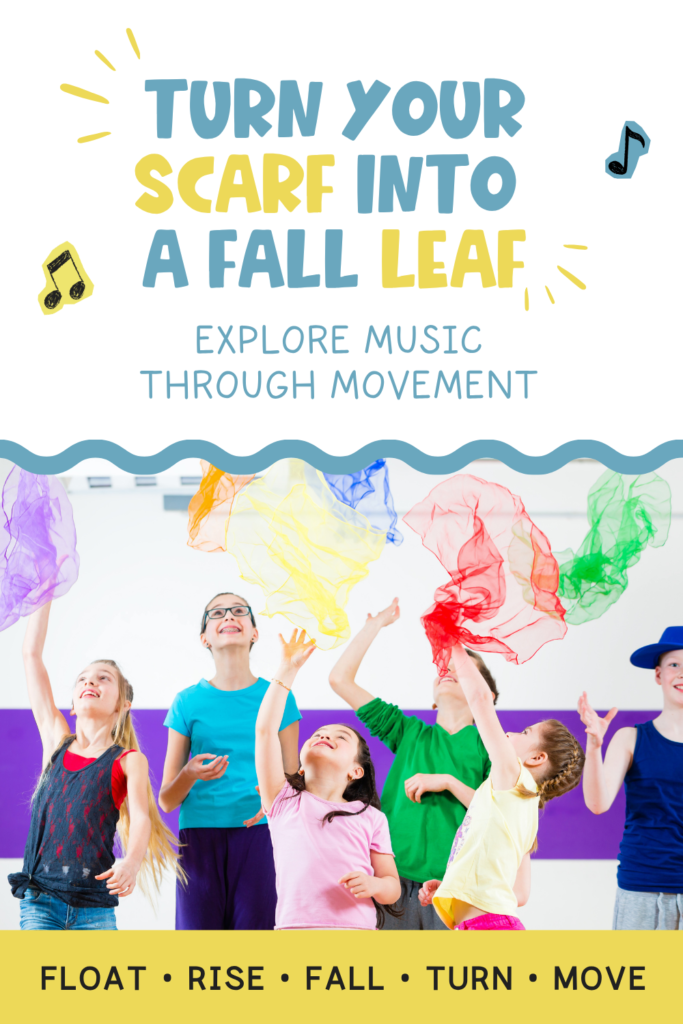
4. Add Scarves to Represent Fall Leaves
Scarves can make this activity even more visual.
Give each student a colorful scarf and imagine that it is a fall leaf.
As the music plays, students can experiment with making their leaf:
- float
- rise
- fall
- travel
- turn
- move quickly or slowly
- remain suspended for a moment
- gently reach the floor
If you have access to real fall leaves and your teaching environment allows it, you could experiment with those as well.
The important part isn’t the object itself.
The scarf or leaf simply gives students something visual that extends the movement of their bodies.
Once they’ve explored freely, we can begin connecting that movement to what they hear.
“Save this idea for later
5. Listen for Melodic Direction
Now I would remove the background music for a moment and begin singing or playing very short tonal patterns.
Keep them simple.
The first question might be:
Did the sound move up or down?
Students can respond with their bodies.
If the pattern moves higher, their imaginary leaf moves upward.
If the pattern moves lower, their leaf moves downward.
Eventually, we can add a third possibility:
Did it stay the same?
Now we have three relationships:
Up ↑
Down ↓
Same →
Students can show their answers using their bodies, hands, scarves, or fall leaves.
I really like this transition because we’re moving from imaginative movement into intentional listening without suddenly changing to a completely different activity.
The fall leaf becomes the connecting idea.
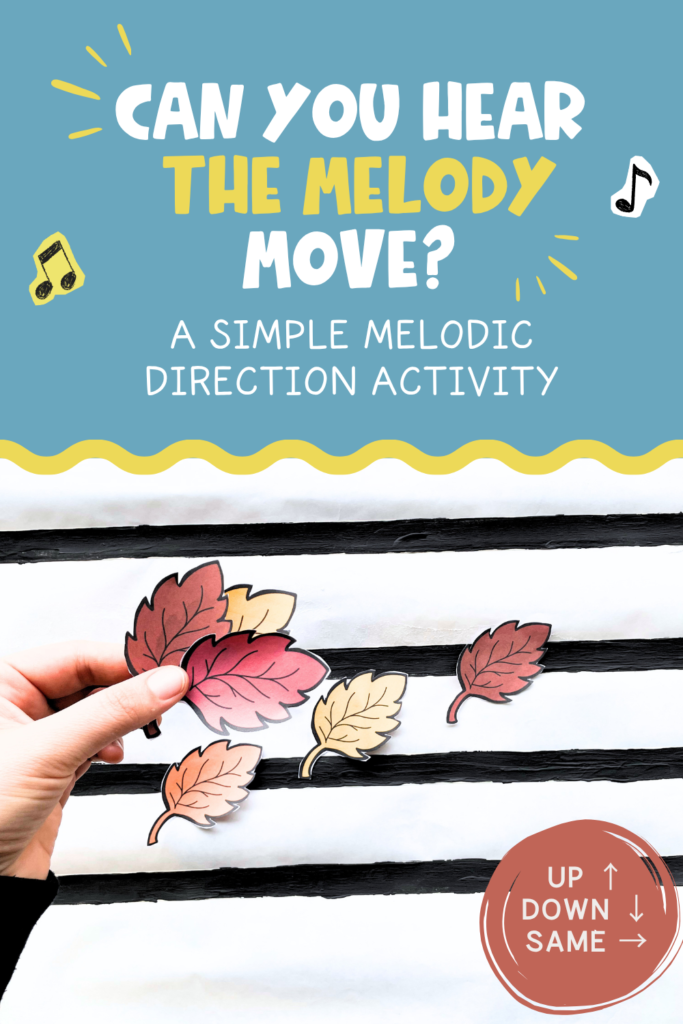
6. Bring the Fall Leaves to the Music Staff
Once students can hear and represent melodic direction, we can make the concept visual.
This is where I would bring out a floor staff.
If you don’t have one, the same activity can easily be adapted to a staff drawn on a whiteboard or another large surface.
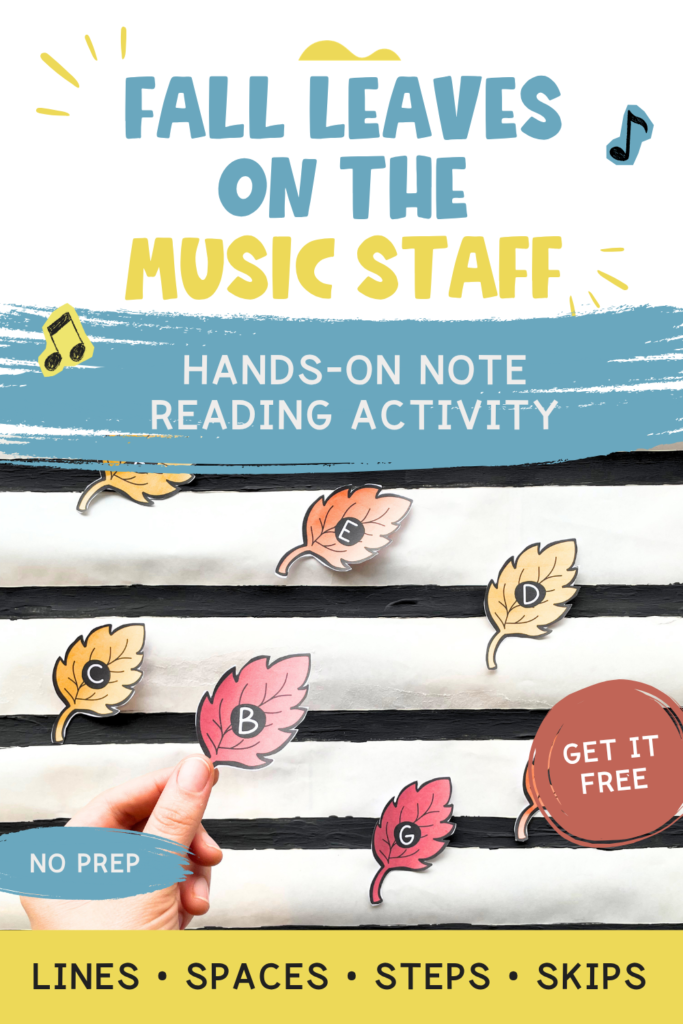
Instead of regular note manipulatives, we’re going to use fall leaves as our notes.
Place a few leaves on the staff and explore what students already experienced with their bodies.
Can you make the leaves move upward?
Can you make them move downward?
Can you create repeated notes?
Can you place all the leaves on lines?
Can you place them in spaces?
Can you create a step?
What about a skip?
The seasonal decoration now has a real musical purpose.
Students aren’t just placing cute leaves on a staff.
They’re beginning to connect:
movement → sound → visual representation
This is the same general idea I use when teaching children to read music: before expecting fluent note identification, I want students to notice how music moves and understand the relationships between notes.
“Save this idea for later
7. Try a Fall Melodic Dictation
Once students understand the activity, the fall leaves can also become simple manipulatives for melodic dictation.
Begin with something very accessible.
Sing or play a short pattern and ask students to represent what they heard.
For beginners, you might only work with:
Up
Down
Same
Later, combine them:
Up – Up – Down
Same – Up – Down
Down – Same – Up
The goal doesn’t have to be identifying exact pitches yet.
Students can first concentrate on hearing relationships between sounds.
As their skills develop, the same activity can become more challenging.
You can introduce steps and skips, longer patterns, or eventually specific note names.
The manipulatives stay the same.
The musical thinking becomes more sophisticated.
“Save this idea for later
8. Add Note Names When Students Are Ready
Eventually, our fall leaves can become actual named notes.
Instead of using blank leaves, introduce leaves labeled:
C – D – E – F – G – A – B
Now there are even more possibilities.
Students can:
- place a specific note on the staff
- create short melodies
- find a note named by the teacher
- arrange notes in ascending or descending patterns
- create steps and skips
- recreate a simple pattern
- practice line and space notes
For students who benefit from additional visual support, color coding can also be incorporated temporarily.
What I love about this progression is that the activity doesn’t begin with:
“Memorize where C, D, E, F, and G are.”
The children have already experienced direction, position, relationships, lines, spaces, steps, and skips.
The note name becomes another layer of information.
“Save this idea for later
Free Fall Music Activity 🍂
Want to try these ideas with your students?
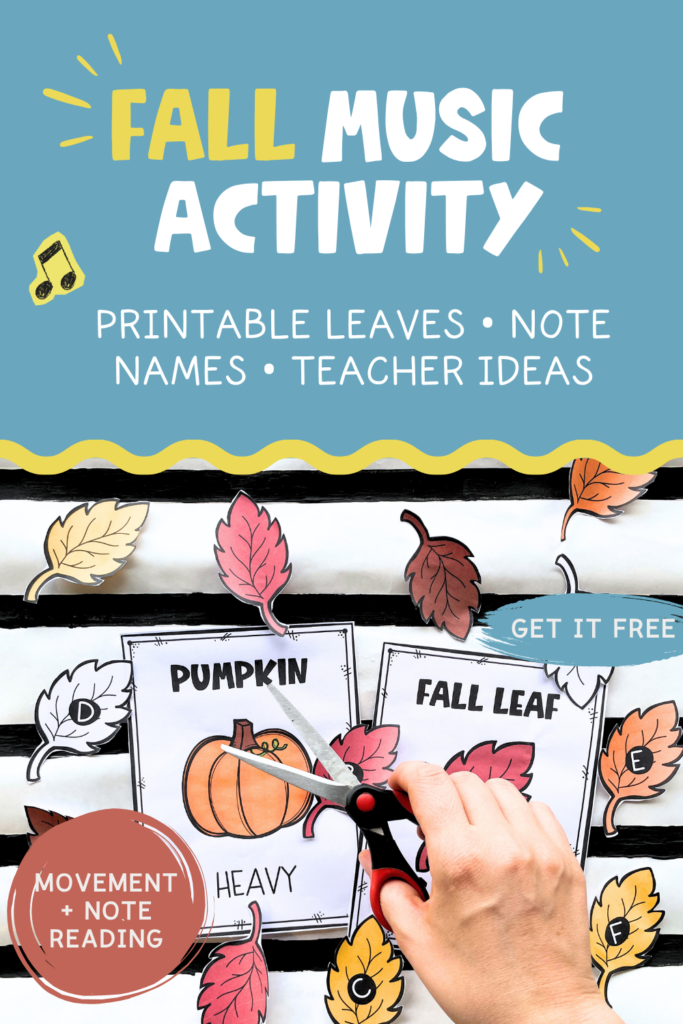
I’ve created a set of Free Printable Fall Music Leaves that you can use with a floor staff, whiteboard, or table activities.
Use them for:
Melodic direction • High and low • Line and space notes • Steps and skips • Note naming • Simple melodic dictation • Music composition
Print, cut, and adapt the activities to the level of your students.
Enter your email below and I’ll send the printable activity directly to your inbox.
🍂 Get the FREE Fall Music Printable!
Bring these fall music activities into your own classroom with this free printable set of fall leaves and movement cards.
Use them to explore heavy and light movement, melodic direction, lines and spaces, steps and skips, and note names through hands-on music activities.
By signing up, you'll receive the free printable plus occasional music teaching ideas, resources, and updates from Sentir Musical Resources. Unsubscribe anytime.
You're in! 🍂🎵
Your free Fall Leaves Music Activity is on its way to your inbox.
Check your email (and your spam or promotions folder, just in case!).
Happy music making! 🎵
9. Move From Hands-On Learning to Paper
After students have experienced these concepts through movement, listening, and hands-on activities, we can reinforce the same ideas on paper.
For example, students might first place fall leaves directly onto the lines and spaces of a floor staff.
Later, they can identify line and space notes on a worksheet.
They might first manipulate C, D, E, F, G, A, and B leaves.
Later, they can practice identifying those notes independently.
The learning sequence becomes:
Experience
↓
Listen
↓
Move
↓
Manipulate
↓
See
↓
Read
↓
Practice
This is where I find worksheets particularly useful.
They’re not replacing the musical experience.
They’re reinforcing it.
Looking for Fall Note Reading Activities?
If you'd like to continue reinforcing these concepts independently, fall-themed worksheets can provide students with additional practice while keeping the visual connection to the season.
You can use them for note reading, line and space recognition, music centers, independent work, early finishers, review, or substitute plans.
10. Add Fall Music Coloring Activities
Not every seasonal activity needs to be teacher-led.
After more active parts of a lesson, I also like having activities available that allow students to work more independently.
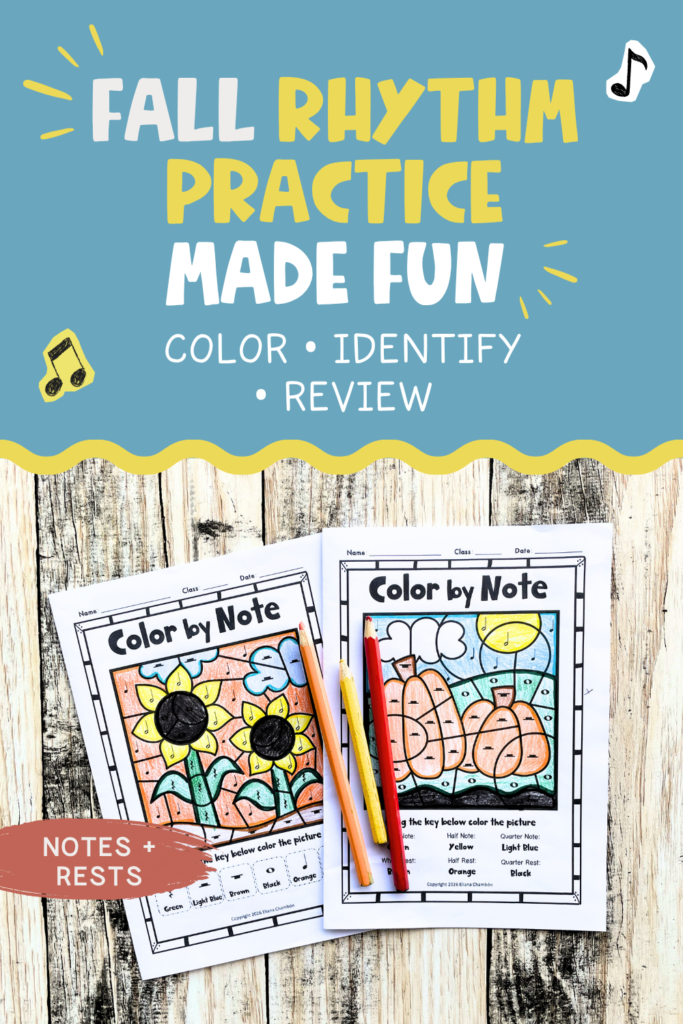
Fall-themed Color by Music activities can be particularly useful for this.
Students can reinforce musical concepts while completing a quieter activity, making them useful for centers, early finishers, review, or moments when you need students working independently.
The important distinction for me is the same one I make with worksheets in general:
The coloring activity isn’t replacing listening, singing, moving, or playing music.
It’s another opportunity to reinforce something students are already learning.
EXPLORE THE FALL COLOR BY MUSIC ACTIVITIES:
🇺🇸 Fall Color by Music Activities
🇪🇸 Actividades de Colorear por Música de Otoño
“Save this idea for later
More Ways to Use the Fall Leaves
Once you’ve prepared the printable leaves, you don’t need to use them for only one lesson.
The same manipulatives can be reused in many different ways.
You might ask students to create a melody that looks like leaves falling from a tree.
Another student could create a pattern and challenge a partner to sing or play it.
Students could sort leaves into line notes and space notes.
You could call out a note and have students race to place the correct leaf on a large staff.
Or students could create their own short fall melody and then perform it.
The important part is that the seasonal theme remains connected to an actual musical objective.
“Save this idea for later
Looking for More Fall Music Activities?
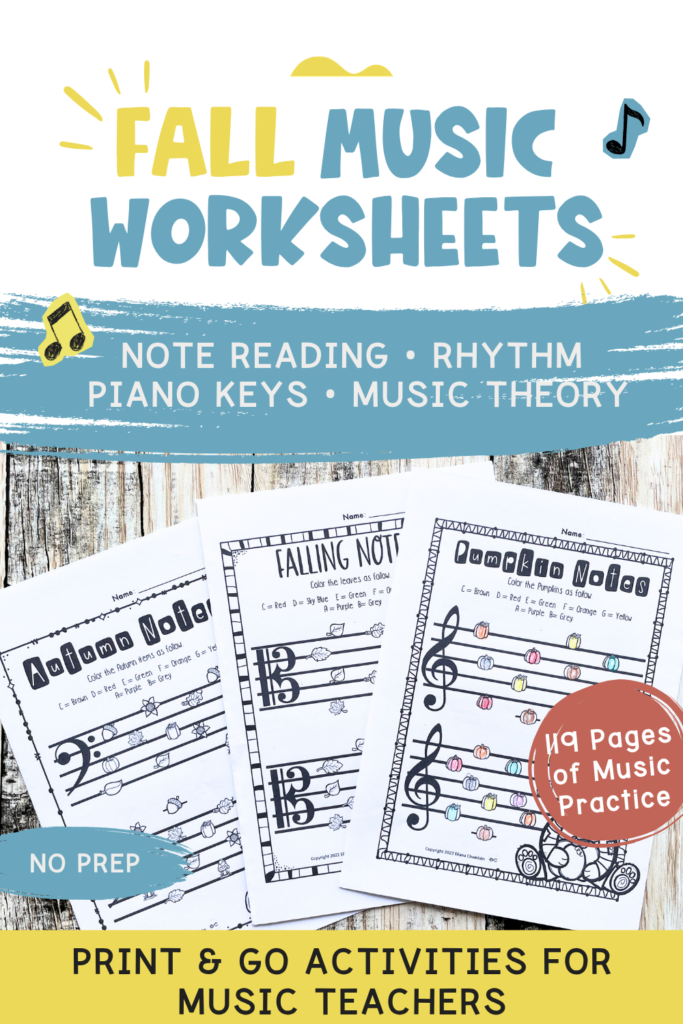
If you'd like ready-to-use printable activities for the season, my Fall Music Worksheets Bundle brings together fall-themed practice for several important music concepts.
The bundle includes activities for:
- Note reading
- Treble and bass clef
- Piano key recognition
- Rhythm and note values
- Time signatures
- Accidentals
- Dynamics
- Music symbols
- And more
The activities can be used for independent practice, music centers, early finishers, small group lessons, review, homework, assessment, or substitute plans.
Fall Themes Can Support Real Musical Learning
Seasonal activities don’t have to be separate from the musical learning happening in your lessons.
A simple fall leaf can become a movement prompt.
Then it can represent melodic direction.
Then it can become a note on a staff.
Eventually, it can help a child read, create, or represent a musical pattern.
That’s what I find most interesting about seasonal teaching ideas.
The theme can capture children’s imagination, but the music remains at the center of the experience.
And when movement, listening, visual representation, hands-on exploration, and written practice are connected, even a simple fall activity can become part of a much deeper musical learning process.
Keep Exploring Music Teaching Ideas 🎵
Looking for more ways to make music learning meaningful and engaging for children? Here are a few related articles you might enjoy:
How to Teach Children to Read Music
Help young music learners develop note reading skills through listening, movement, melodic patterns, hands-on staff activities, and visual supports before expecting them to memorize every note.
[READ HOW TO TEACH CHILDREN TO READ MUSIC →]
How to Teach Music Theory Without Making It Boring
Explore practical ways to teach music theory through musical experiences first, followed by games, activities, and meaningful practice. Discover ideas for rhythm, note reading, intervals, key signatures, and more.
[EXPLORE HOW TO TEACH MUSIC THEORY →]
More Music Teaching Ideas Coming Soon
I’m always creating new ideas, activities, and resources to help children experience music before connecting those experiences to musical concepts and notation.