

Learning how to teach children to read music is about much more than helping them memorize the names of the notes on the staff.
Of course, students eventually need to recognize individual notes. But over the years, I’ve found that music reading becomes much more natural when children also understand what the notes are doing.
Is the melody moving up or down?
Is the pitch getting higher or lower?
Are the notes repeating?
Are they moving by step or by skip?
These are some of the questions I explore with students long before I expect them to read a melody fluently.
My goal is to create a connection between what students hear, what they see, and what they eventually read on the staff.
Here are some of the strategies I use to make that happen.
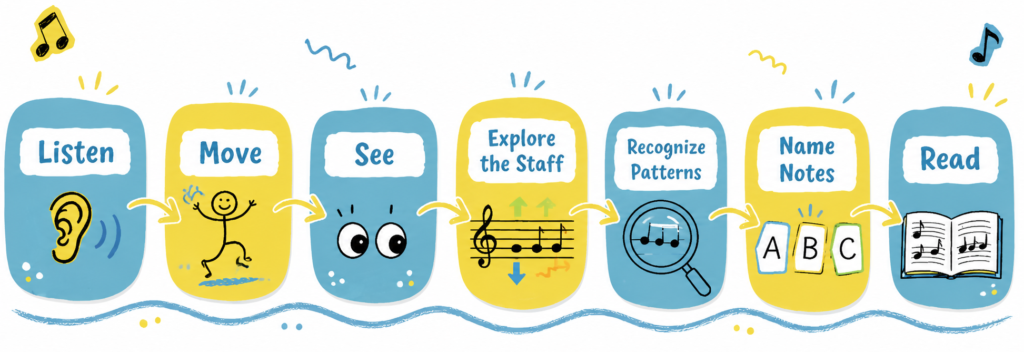
1. Start with High and Low Sounds
Before focusing on note names, I like to explore one of the simplest musical relationships children can recognize: high and low sounds.
We listen to different sounds and compare them.
Which one sounds higher?
Which one sounds lower?
What happens when the melody moves upward?
What happens when it moves downward?
Singing is wonderful for this. I can sing short tonal patterns and ask students to listen to the direction of the melody. We can also use movement to represent what we hear.
Then I connect those listening experiences to something visual.
If a sound becomes higher, what happens to the notes on the staff?
They move up.
If the sound becomes lower, what happens?
They move down.
This simple connection between sound and visual representation is something I continue reinforcing throughout the entire note-reading process.
I don’t want students to simply see that the notes go up.
I want them to understand what up sounds like.
2. Explore How the Staff Works
Once students are beginning to recognize melodic direction, we explore the staff itself.
We talk about the five lines and four spaces and notice that notes can sit either on a line or in a space.
At this stage, there is already so much we can do without worrying about memorizing every note name.
Students can identify:
- line notes and space notes
- notes that move higher or lower
- repeated notes
- notes moving up or down
- steps and skips
This gives children an opportunity to understand the visual language of notation before adding another layer of information.
3. Teach Children to See Musical Patterns
This is probably one of the most important parts of my approach.
When we read a word, we eventually stop reading every individual letter.
We recognize the word.
Music reading can develop in a similar way.
A beginning student might look at a melody and think:
C – D – E – F – G
But eventually, I want them to begin seeing something more like:
start here → step up → step up → step up → step up
They still need to know the names of the notes, of course. But recognizing the relationship between notes makes reading much more fluent.
That’s why I spend time working with:
Repeated notes. Steps. Skips. Leaps. Melodic direction.
If students recognize that two notes are next to each other on the staff, they begin to understand the relationship before consciously naming every single pitch.
The first note becomes a reference point, and the movement of the melody provides additional information.
This becomes increasingly important as the music gets more complex.
Instead of decoding every note as an isolated symbol, students begin to read musical patterns.
Want to Try Some Music Theory Activities for Free?
If you’d like to try some of my printable activities with your students, you can download my Free Music Theory Worksheets Sampler.
It includes sample activities for note reading, rhythm, intervals, and key signatures, so you can explore different ways to reinforce music theory concepts after students have experienced them through listening, movement, games, and music-making.
4. Make the Staff Something Children Can Touch
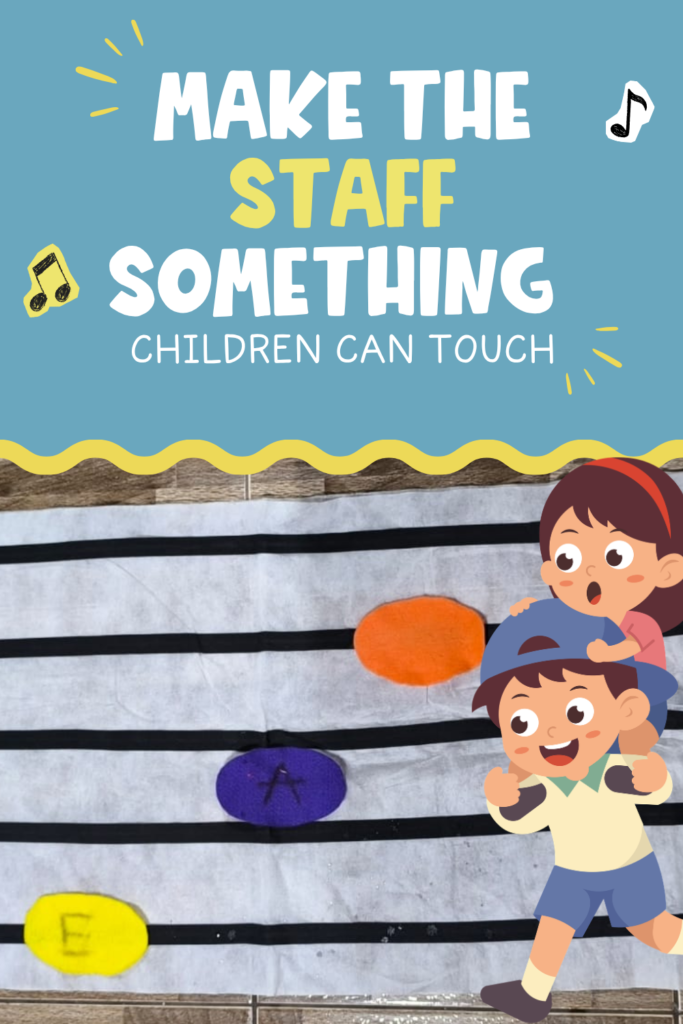
One of my favorite tools for teaching note reading is incredibly simple: a giant floor staff.
I made mine using a large piece of white fabric and five black strips to create the staff lines. I also made colored circles that we can move around the staff as notes.
This turns something that can feel very abstract on paper into something students can physically manipulate.
Before we even use note names, I can ask students to create:
- a melody that moves up
- a melody that moves down
- repeated notes
- line notes
- space notes
- two steps
- a skip
- different melodic patterns
We can also sing patterns and recreate what we hear on the floor staff.
Later, when students begin learning note names, we use exactly the same material.
Now those colored circles aren’t simply moving up and down.
They become C, D, E, F, G, A, and B.
The concept hasn’t suddenly changed.
We’ve simply added another layer of understanding.
 “Save this idea for later
5. Use Reference Notes Instead of Memorizing Everything at Once
When I introduce note names, I like to give students visual reference points.
For example, in treble clef, G is an especially useful reference because the treble clef itself curls around the second line—the G line.
Middle C is another important landmark. Its ledger line makes it visually distinctive and gives students another reference point.
In bass clef, F becomes an important reference because the two dots of the bass clef surround the fourth line, where F is located.
These landmarks help students orient themselves on the staff.
Instead of every note feeling like an entirely new piece of information to memorize, students can begin thinking about where a note is in relation to something they already know.
6. Use Color Coding as a Support, Not a Replacement
Color coding has been one of the most useful tools in my teaching, especially with very young beginners.
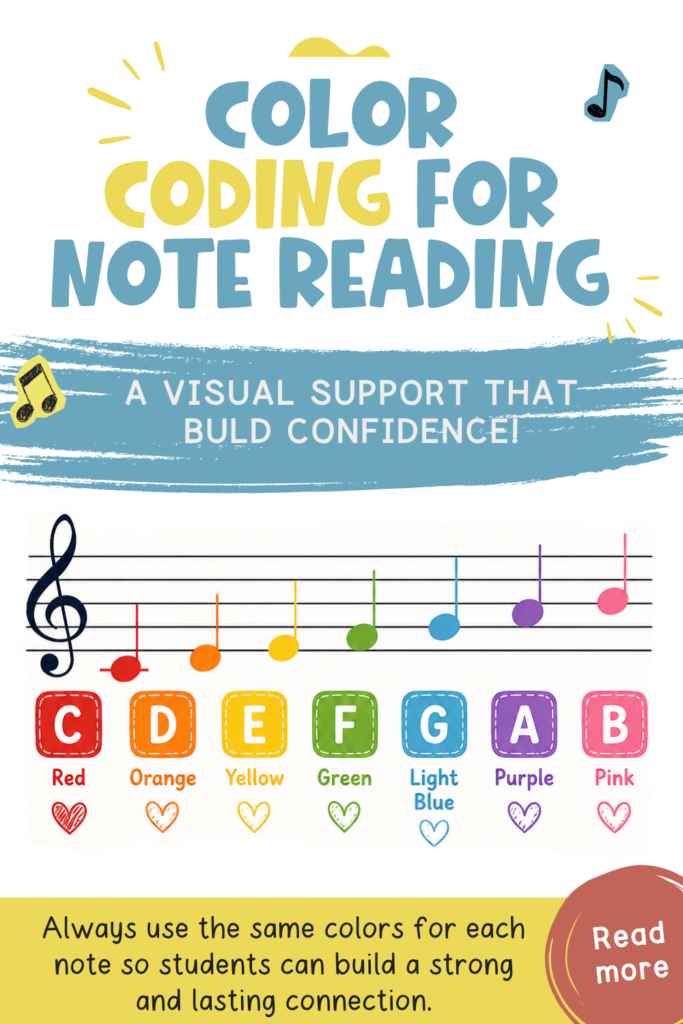
I consistently associate each note with the same color:
C – Red
D – Orange
E – Yellow
F – Green
G – Light Blue
A – Purple
B – Pink
The important part is that I use color as a temporary visual support.
I don’t write the note name underneath every note.
There’s an important difference.
If I write the letter name under the note, the student’s attention can move away from the staff entirely. Instead of reading the notation, they simply read the letter.
With color coding, the note itself remains the focus.
The student is still looking at its position on the staff. They repeatedly see that same note, in that same place, associated with the same color.
Over time, I gradually remove the color support.
Less color.
Then even less.
Eventually, no color at all.
I’ve used this approach even with four-year-old piano students, and I’ve seen children gradually begin recognizing the notes independently because the visual support helped them build the connection without replacing the notation itself.
“Save this idea for later
7. Practice Note Names Through Games
Once students are ready to practice individual note names, repetition becomes important.
But repetition doesn’t have to mean doing the same exercise again and again.
This is where I use lots of games.
Memory games, board games, spinners, matching activities, and challenges at the floor staff can all reinforce exactly the same skill in different ways.
For example, a student might spin a wheel, get a note name, and then have to place that note correctly on the staff.
The learning objective is still note recognition.
The format simply makes the repetition much more engaging.
Games and color coding have probably been two of my biggest allies when helping young students become confident with note names.
“Save this idea for later
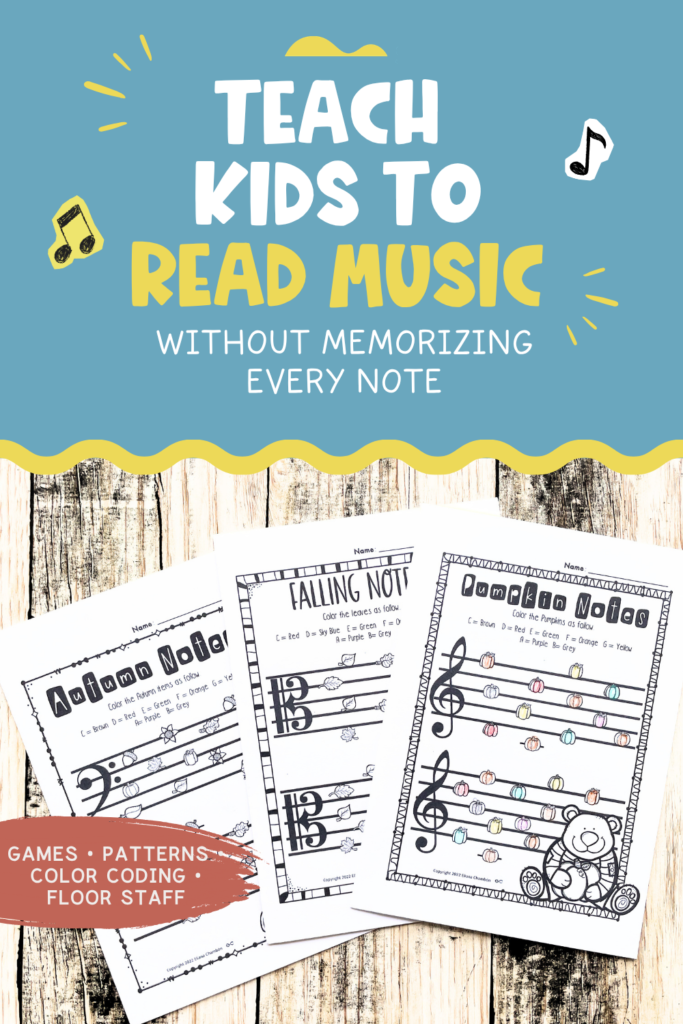
8. Reinforce Learning with Note Reading Worksheets
I also use a lot of printable activities.
Once students have explored the staff, melodic direction, steps and skips, reference notes, and note names through musical and hands-on experiences, worksheets become extremely useful.
Students can work independently on line and space notes, note identification, melodic patterns, treble and bass clef reading, and other concepts we’ve already explored together.
For me, worksheets aren’t where music reading begins.
They’re one of the tools that help students practice, reinforce, and eventually become fluent with what they’ve already learned.
Free Music Teaching Resources
Get free printable music worksheets, teaching tips, and low-prep activities for rhythm, piano, ukulele, music theory, and elementary music.
No spam. Just practical ideas and free resources for music teachers.
You're in! Thank you for subscribing.
Please check your inbox soon. I’ll be sending free music teaching resources, classroom ideas, and low-prep activities to support your lessons.
Looking for Ready-to-Use Note Reading Activities?
If you’re looking for printable activities to help students practice note reading, I’ve created a collection of Music Note Reading Worksheets designed to reinforce the same skills we explore through games, movement, and hands-on activities.
Students can practice identifying notes on the staff, recognizing line and space notes, building note-reading fluency, and strengthening their confidence with written notation.
They’re perfect for independent practice, music centers, early finishers, review, homework, or piano lessons.
Teaching Children to Read Music Fluently
Ultimately, I don’t want students to look at a piece of music and spend the entire time decoding one isolated note after another.
I want them to see relationships.
I want them to recognize where the melody is going.
I want them to notice repeated notes, steps, skips, and larger intervals.
And I want what they see on the page to connect with something they’ve already heard, sung, moved to, played, or experienced.
Knowing note names is important.
But reading music is bigger than naming notes.
When children begin connecting sound, movement, patterns, position, and notation, the staff stops looking like a collection of mysterious symbols.
It begins to look like music.
Looking for a Complete Music Theory Resource?
Note reading is just one part of developing strong music literacy.
If you’re looking for printable activities that go beyond note reading, my Music Theory Worksheets Mega Bundle brings together a growing collection of resources for practicing essential music theory concepts.
Students can reinforce skills including note reading, rhythm, intervals, key signatures, music symbols, treble and bass clef, ledger lines, the musical alphabet, and more.
It’s designed to give you a ready-to-use library of printable activities for independent practice, review, music centers, assessments, early finishers, and lessons throughout the year.
FAQ About Teaching Children to Read Music
What is the best way to teach children to read music?
I like to begin by helping children understand how music moves before asking them to memorize individual note names.
We explore high and low sounds, melodic direction, repeated notes, steps, and skips through listening, singing, movement, and hands-on activities.
Then I connect those experiences to what students see on the staff.
Should children memorize note names first?
I don’t usually begin with memorization.
Knowing note names is important, but I also want students to recognize patterns and relationships between notes.
Understanding whether a melody moves up, down, by step, or by skip can help students become much more fluent readers instead of decoding every note individually.
How do you teach the music staff to beginners?
I begin with the basic structure of the staff: five lines and four spaces.
We identify line notes and space notes and explore where notes can move on the staff.
I also love using a large floor staff so students can physically place notes, create patterns, and explore melodic direction before working only on paper.
Does color coding help children learn music notes?
Color coding can be a helpful temporary visual support, especially for young beginners.
I consistently associate each pitch with the same color while keeping the actual note visible on the staff.
As students become more confident, I gradually remove the colors so they learn to recognize the notes independently.
Is it better to use colors or write note names under the notes?
I prefer color coding to writing note names underneath every note.
When the note name is written below the staff, students may focus on reading the letter instead of looking at the notation.
With color coding, their attention remains on the note and its position on the staff while still receiving additional visual support.
What are some fun ways to practice note reading?
Games are one of my favorite ways to build note-reading fluency.
Memory games, board games, matching activities, spinners, floor staff challenges, and note-reading worksheets can all provide repetition without making practice feel repetitive.
I like to combine these activities so students encounter the same musical concepts in different ways.
Continue Exploring Music Teaching Ideas
If you’d like to explore more ways to help children understand music through meaningful, hands-on experiences, you may also enjoy:
🎵 How to Teach Music Theory in a Way Students Actually Understand
👉 Explore my complete approach to connecting musical experiences with notation and written music theory.
🥁 How I Teach Beginner Rhythm
👉 See the step-by-step sequence I use to introduce rhythm through movement, listening, creativity, games, and notation.
🎹 5 Fun Resources for Teaching Piano Keys to Kids
👉 Discover hands-on activities and games for helping young beginners become familiar with the piano keyboard.