

Color by Music worksheets can be used to practice much more than note names.
The same color-by-code activity format can be adapted to rhythm, note reading, piano keys, intervals, music math, ukulele chords, and other musical concepts.
That’s one of the things I enjoy most about designing these activities. Students can become familiar with how the activity works while the musical challenge changes.
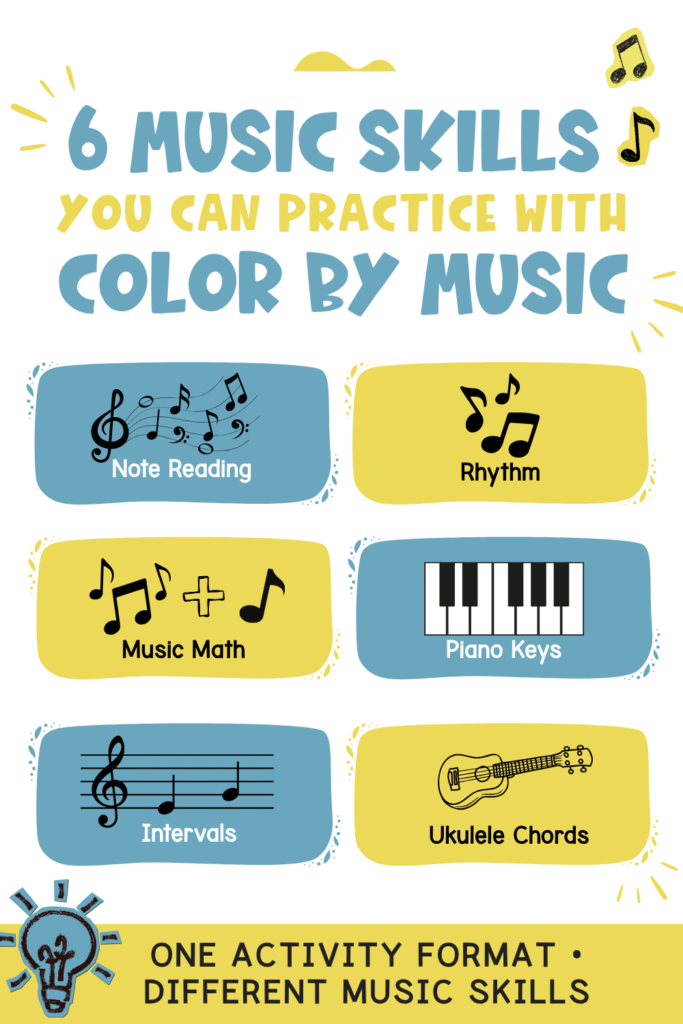
One worksheet might ask students to identify notes on the staff. Another might require them to recognize rhythmic values, solve a music math problem, identify an interval, find a piano key, or recognize a ukulele chord.
Let’s take a look at some of the different ways Color by Music worksheets can be used to practice music skills.
 “Save this idea for later

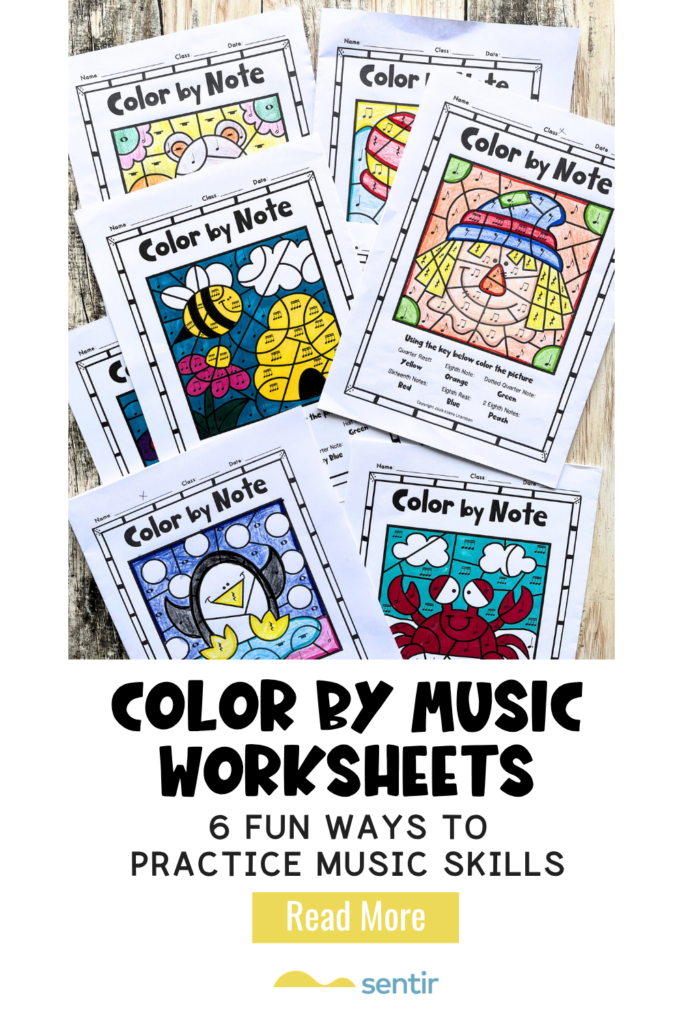
What Are Color by Music Worksheets?
Color by Music worksheets combine a musical task with a color-by-code activity.
Instead of simply coloring a picture, students first need to identify or solve something musical. Their answers then determine which colors they use to complete the picture.
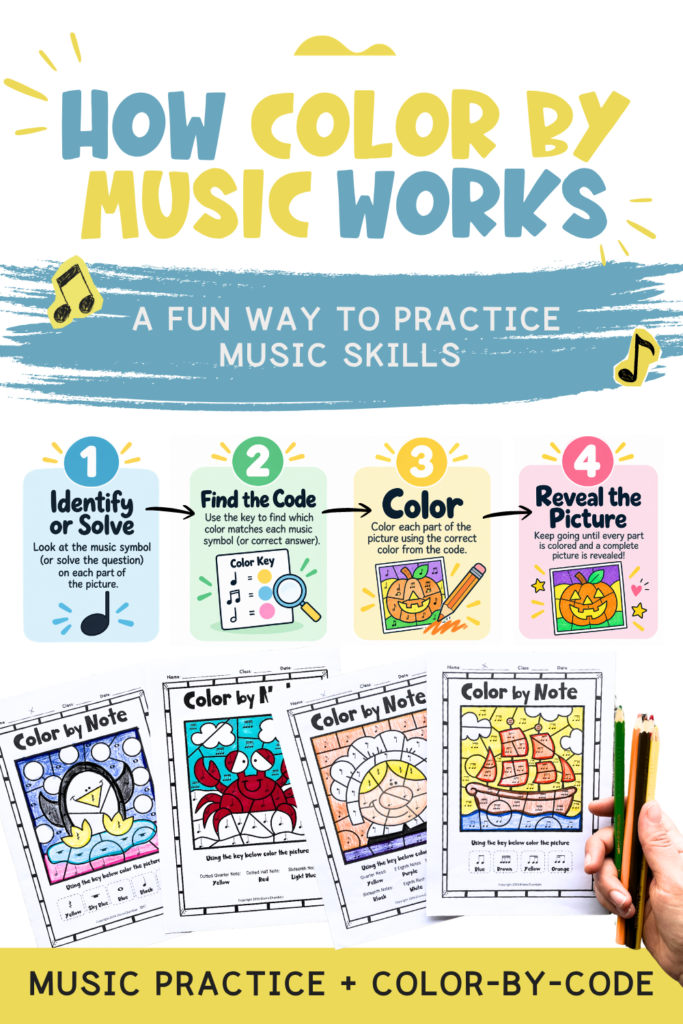
Depending on the activity, the process might look something like this:
Identify or Solve → Find the Code → Color → Reveal the Picture
In many of my resources, I design the activity so that students need to focus on the musical question before completing the coloring portion.
For example, they might identify an interval, solve a music math problem, recognize a rhythm, or find a note on the keyboard. Once they have the answer, they can use the color code to complete the picture.
This keeps the musical challenge at the center of the activity while still giving students the satisfaction of revealing a finished picture.
“Save this idea for later
1. Color by Note 🎼
Color by Note worksheets combine note-reading practice with a color-by-code activity.
Students identify notes on the staff and use their answers to determine how different sections of the picture should be colored.
Depending on the resource, students can practice skills such as:
- Identifying note names
- Reading notes in treble clef
- Reading notes in bass clef
- Recognizing notes on lines and spaces
The musical task remains note recognition, while the coloring gives students a visual goal to work toward as they complete the activity.
Color by Note vs. Color Coding for Note Reading
There’s an important distinction between these two ideas.
When color coding is used as a temporary visual support for beginning note readers, a consistent color system can help students make connections between pitch names and their positions on the staff.
A Color by Note worksheet doesn’t necessarily work that way.
The colors can simply function as the code for that particular activity. Students still need to identify the note correctly before they know which color to use.
In other words, the goal isn’t to learn that a particular note “is” a particular color.
The goal is to read the note.
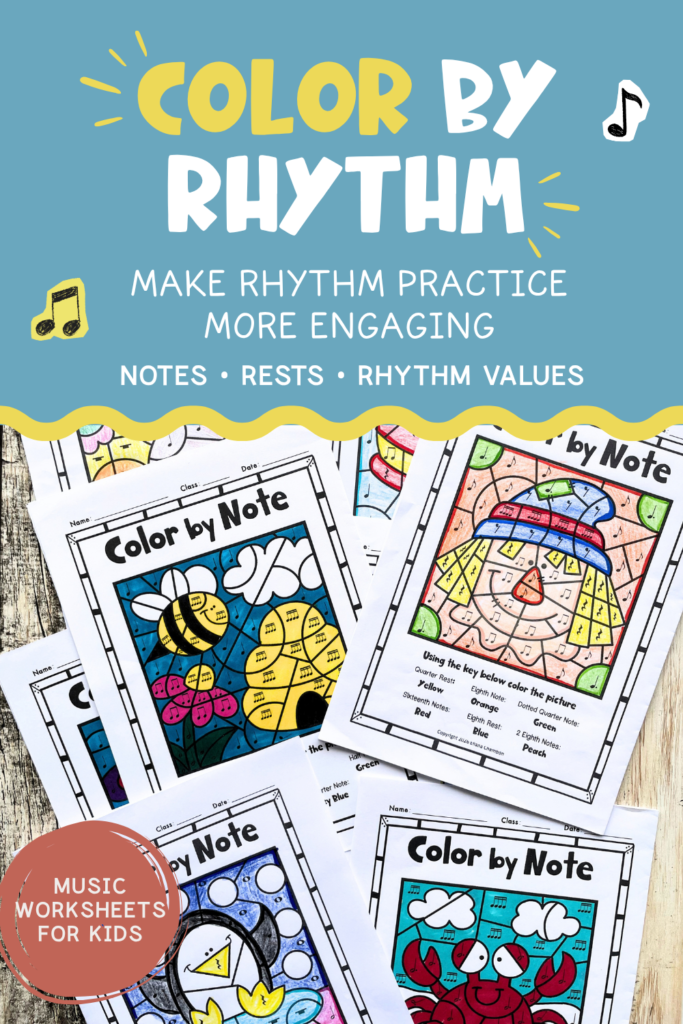
2. Color by Rhythm 🥁
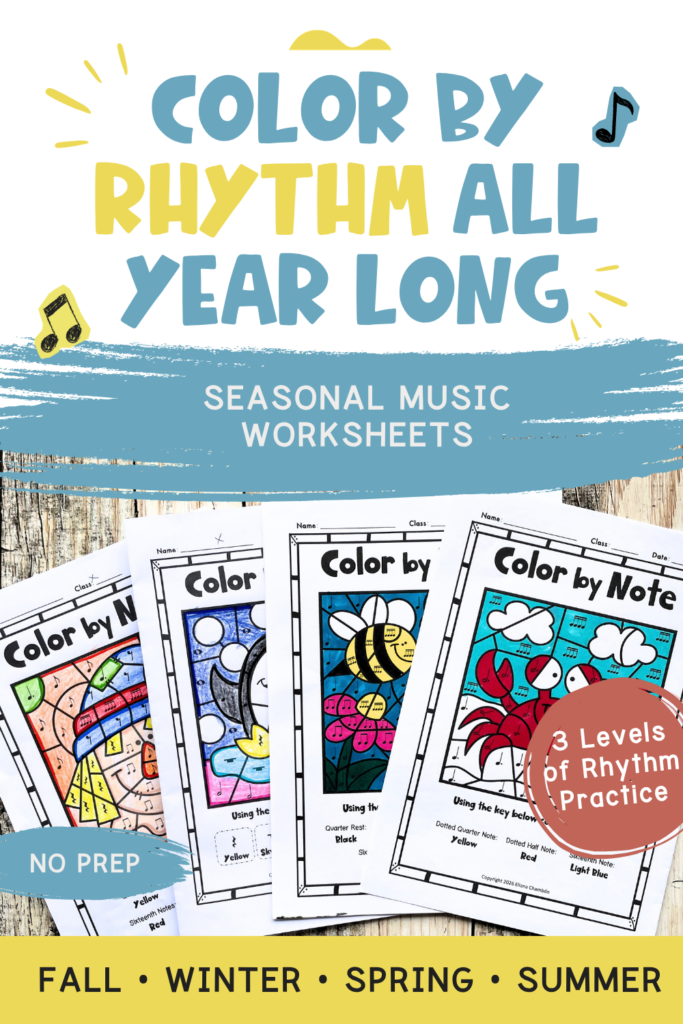
Color by Rhythm is one of the formats I’ve developed most extensively because rhythm lends itself particularly well to different levels of difficulty.
Students identify notes, rests, note values, or rhythmic combinations and then use their answers to complete the color code.
A beginner activity can focus on more fundamental note values and rests, while subsequent levels can introduce eighth notes, sixteenth notes, dotted rhythms, and more challenging combinations.
In my Color by Rhythm collections, I use three levels so teachers can choose an activity that better matches the rhythmic concepts their students are currently practicing.
This means the coloring format isn’t limited to very young beginners. The visual activity can remain familiar while the rhythm work becomes progressively more challenging.
I also create Color by Rhythm activities with different seasonal and holiday themes, making it possible to revisit rhythm practice at different points throughout the year without every worksheet looking the same.
“Save this idea for later
3. Color by Music Math ➕🎵
Color by Music Math adds a problem-solving step to the activity.
Instead of simply recognizing a note or rest, students use their understanding of musical values to solve a problem before finding the corresponding color.
The process becomes:
Recognize → Calculate → Find the Answer → Color
For example, students might need to look at a combination of note values, calculate the total, and then use that result to determine the correct color.
This gives students another way to work with note values while adding a mathematical challenge to the activity.
Music Math can also be differentiated. I design different levels so that students can begin with simpler note-value calculations and gradually work with more challenging combinations.
The result is an activity that reinforces both recognition of musical values and the ability to use those values to solve a problem.
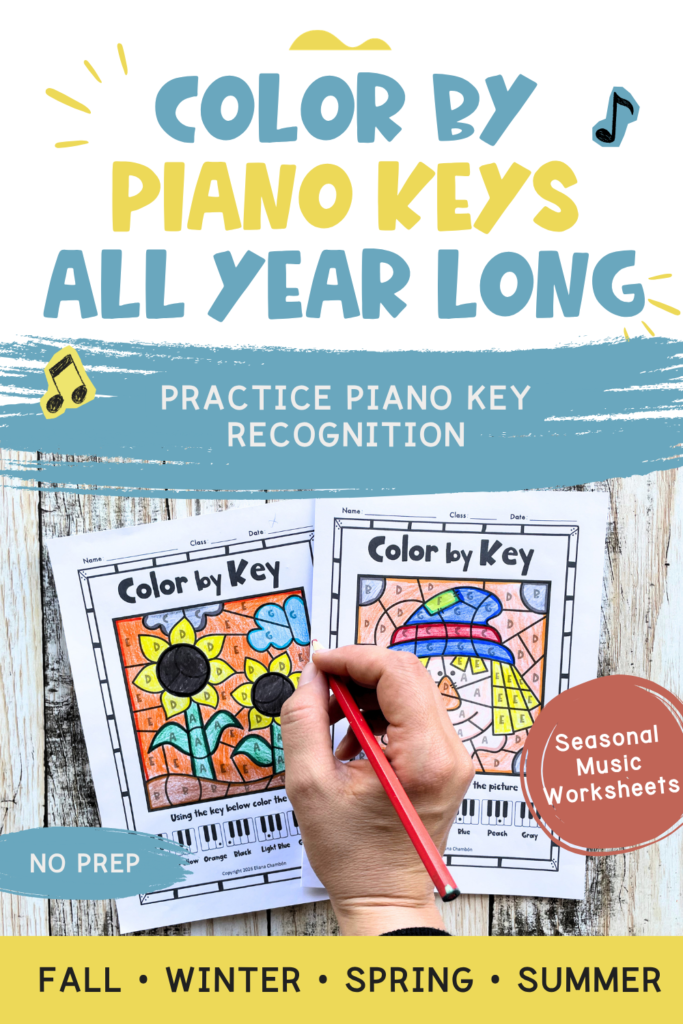
4. Color by Piano Keys 🎹
Color by Piano Keys moves the activity away from the staff and onto the keyboard.
Students identify piano keys and use their answers to determine the correct colors for the picture.
These activities can reinforce:
- Piano key names
- Keyboard note recognition
- The repeating pattern of notes across the keyboard
- Basic keyboard geography
I especially like this variation because it shows that Color by Music doesn’t always have to mean reading traditional notation.
Students still need to recognize musical information, but this time they’re working directly with the layout of the piano keyboard.
I create Color by Piano Keys activities for different seasonal and classroom themes, including a Seasonal Color by Piano Keys collection for Fall, Winter, Spring, and Summer.
This gives students opportunities to revisit piano key recognition throughout the year while working with different seasonal pictures.
5. Color by Intervals 🎶
Color by Intervals asks students to look at the relationship between notes rather than identifying only one note at a time.
In these activities, students first identify the interval and then use their answer to determine the corresponding color.
I particularly like keeping the musical problem-solving stage clear in this type of activity:
Identify the Interval → Find the Answer → Check the Code → Color
This helps keep students focused on actually identifying the interval rather than trying to predict the finished picture.
The difficulty can also be adjusted. My Color by Interval resources include different levels, allowing students to work with interval recognition at different stages.
This makes it possible to keep the activity format familiar while changing the musical challenge students need to solve.
6. Color by Ukulele Chords 🪕
Color by Music can also be adapted to instrument-specific skills.
With Color by Ukulele Chords, students identify chord diagrams and use the chord names to complete the color code.
Depending on the resource, activities can include major, minor, and seventh chords or focus on chords within particular keys.
I’ve also created beginner activities that concentrate on smaller groups of chords, as well as seasonal activities that provide opportunities to revisit chord recognition throughout the year.
These worksheets can provide students with another way to reinforce chord recognition alongside their actual ukulele playing.
The instrument may be different, but the goal remains musical: students need to recognize the chord correctly before they can complete the coloring activity.
“Save this idea for later
Different Levels for Different Learners
Not every student needs to practice the same musical concepts at the same level.
That’s one reason I like creating different levels within some of my Color by Music collections.
For example, my Color by Rhythm activities progress from more fundamental note values and rests to eighth and sixteenth notes and then to dotted rhythms and more advanced combinations.
Some of my Music Math and Interval resources also include different levels, allowing teachers to select an activity that better matches the concepts their students are ready to practice.
The goal isn’t simply to make one worksheet “easy” and another “hard.”
Instead, the musical content can change as students develop their skills, while the overall activity structure remains familiar.
“Save this idea for later
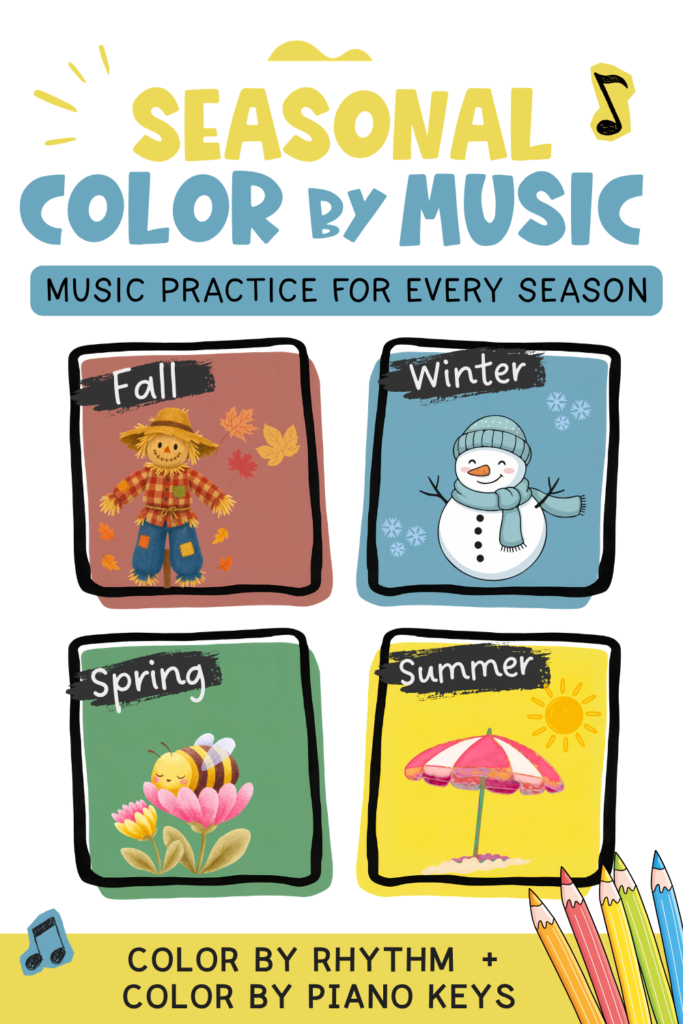
Seasonal Color by Music Activities 🍂❄️🌸☀️
Color by Music activities can also be adapted throughout the year with seasonal themes.
I create seasonal collections that allow students to practice the same type of musical skill while the pictures and themes change with the seasons.
For example, my seasonal collections include Color by Rhythm and Color by Piano Keys activities for:
 Fall •
 Winter •
 Spring •
 Summer
The musical skill remains the important part of the activity. The seasonal pictures simply provide a new visual theme as students continue practicing throughout the year.
The seasonal theme adds interest. The musical skill remains the focus.
In addition to the four seasons, you can find Color by Music activities for holidays and classroom themes such as Valentine’s Day, St. Patrick’s Day, Easter, Halloween, Thanksgiving, Christmas, Back to School, and more.
“Save this idea for later
“Save this idea for later
When Can You Use Color by Music Worksheets?
Color by Music worksheets can fit into many different teaching situations, especially once students understand the musical concept they’re practicing and how the activity works.
You can use them for:
- Music centers
- Independent practice
- Early finishers
- Review
- Small groups
- Private music lessons
- Homework
- Sub plans
- Seasonal music lessons
They can also be helpful when some students are ready to work independently while you support another student or small group.
Because students can become familiar with the basic color-by-code structure, you don’t necessarily need to introduce a completely new type of worksheet every time you want them to practice another musical concept.
Instead, the instructions remain relatively familiar while the musical content changes.
Where Do Color by Music Activities Fit?
I primarily design Color by Music worksheets as a way to practice and reinforce musical concepts.
They don’t replace listening, singing, moving, playing, creating, or making music.
Instead, they’re another tool students can use to revisit musical concepts in a different—and often more independent—way.
That can be particularly useful after a concept has already been introduced and students need additional opportunities to recognize, solve, and practice it.
If you’re looking for more ideas about how I approach music theory beyond worksheets, you can also read:
Final Thoughts
Color by Music can be adapted to many different musical concepts.
Students might be reading notes in one activity, identifying rhythms in another, solving Music Math problems, recognizing piano keys or intervals, or identifying ukulele chords.
The coloring element can make the activity visually engaging, but the musical task remains the reason for completing it.
That’s what I want these resources to provide: another practical way for students to practice musical skills they’re already learning.
And as my Color by Music collection continues to grow, I’ll keep adding new musical skills, levels, seasonal themes, and activities for teachers to explore.