

Helping young students build rhythm skills through movement, play, and meaningful music-making.
When I first started teaching music, I thought introducing rhythm meant showing students rhythm symbols as soon as possible.
Quarter notes.
Eighth notes.
Half notes.
Whole notes.
Then I completed my certification in Edwin Gordon’s Music Learning Theory (MLT), and it completely changed the way I think about teaching music.
I still teach rhythm notation.
I still teach music theory.
But I no longer start with the symbols.
I start with music.
Before my students ever read a quarter note, they’ve already experienced rhythm through movement, chants, songs, body percussion, and imitation.
Because that’s how we naturally learn every language.
We listen.
We move.
We imitate.
We experiment.
Only then do we learn to read and write.
Music works the same way.
Once students have experienced rhythm with their bodies and voices, introducing notation becomes much more meaningful.
In this article, I’ll share the exact sequence I use in my elementary music classroom to teach beginner rhythm. It’s a sequence I’ve refined over the years, and it helps my students build confidence while genuinely enjoying the learning process.
 “Save this idea for later
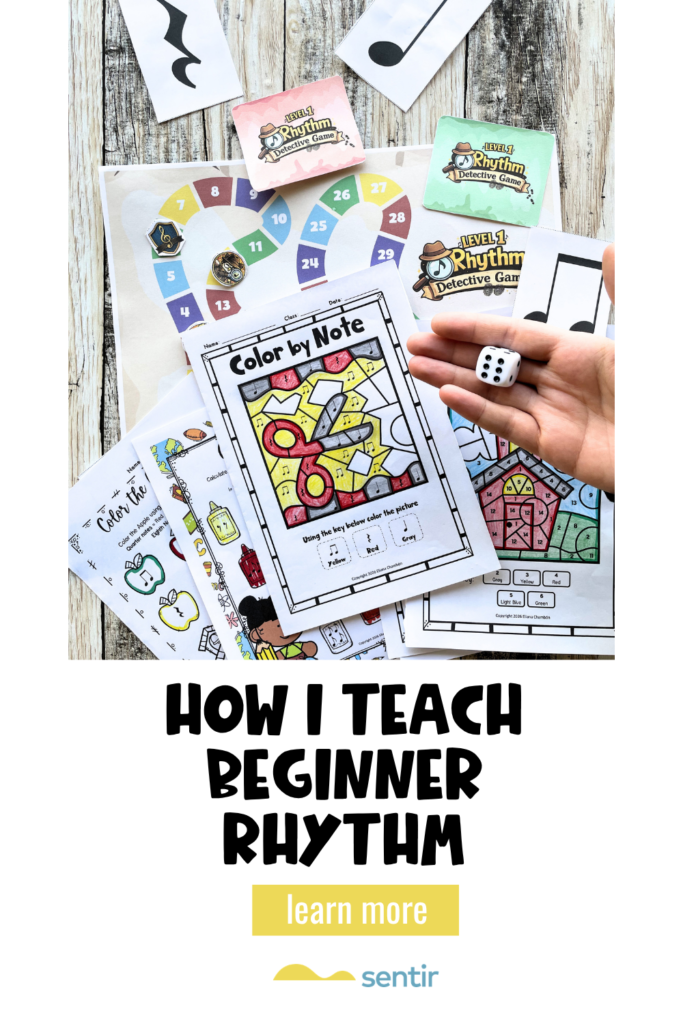
🇺🇸 Explore the Complete Beginner Rhythm Activities Bundle
🇪🇸 Explora el Paquete Completo de Actividades de Ritmo para Iniciantes
Why I Keep Beginner Rhythm Simple
One of the most common mistakes I see is introducing too many rhythm values too early.
It’s tempting to teach quarter notes, half notes, whole notes, dotted half notes, and sixteenth notes all within the first few lessons.
But in my experience, that’s often overwhelming for young learners.
Long note values are actually harder for many children to perform because they have to sustain the beat for a longer period of time. Shorter rhythms like quarter notes and beamed eighth notes feel much more natural. Students can move them, clap them, and internalize them more easily.
That’s why I spend most of first grade focusing on just three rhythm symbols:
- Quarter Note
- Beamed Eighth Notes
- Quarter Rest
Sometimes I introduce the half note later, depending on the curriculum and the students’ progress, but these three symbols become the foundation for everything else.
I don’t believe rhythm is a unit that students “finish.”
Instead, we revisit these concepts throughout the entire school year in different ways until they become part of each student’s musical vocabulary.
Free Music Teaching Resources
Get free printable music worksheets, teaching tips, and low-prep activities for rhythm, piano, ukulele, music theory, and elementary music.
No spam. Just practical ideas and free resources for music teachers.
You're in! Thank you for subscribing.
Please check your inbox soon. I’ll be sending free music teaching resources, classroom ideas, and low-prep activities to support your lessons.
My Teaching Philosophy
My teaching has been deeply influenced by Music Learning Theory.
That doesn’t mean every lesson is based entirely on MLT, but it changed the order in which I teach.
Instead of beginning with notation, I begin with musical experiences.
My sequence usually looks like this:
Listen → Move → Imitate → Create → Read → Write
Before asking students to identify a rhythm symbol on paper, I want them to feel that rhythm in their body.
If students cannot confidently perform a rhythm with their voice or through movement, reading and writing that rhythm will almost always be more difficult later.
That’s why every lesson begins with music first.
Step 1 – Experience Rhythm Before Seeing It
Every class starts with a short musical routine.
We sing.
We chant.
We move.
We echo rhythm patterns.
Sometimes we use body percussion.
Sometimes we move with scarves.
Other times we simply walk the beat while echoing short rhythmic patterns.
These activities only last a few minutes, but they make a huge difference.
Students are already experiencing rhythm long before we introduce notation.
Many teachers use Kodály rhythm syllables such as ta and ti-ti.
I often use the rhythm syllables from Music Learning Theory.
The specific system isn’t the most important part.
Consistency is.
The goal is helping students connect sound, movement, and rhythm before introducing visual symbols.
Teacher Tip
If you teach rhythm symbols before students have experienced rhythm through movement and listening, notation can easily become a decoding exercise instead of real music-making.
Step 2 – Introduce the Rhythm Symbols
Once students are comfortable hearing and performing simple rhythm patterns, I begin introducing the notation.
Only three symbols.
Quarter Notes.
Beamed Eighth Notes.
Quarter Rests.
At this stage, I simply want students to answer three questions:
- What is this symbol called?
- What does it look like?
- How does it sound?
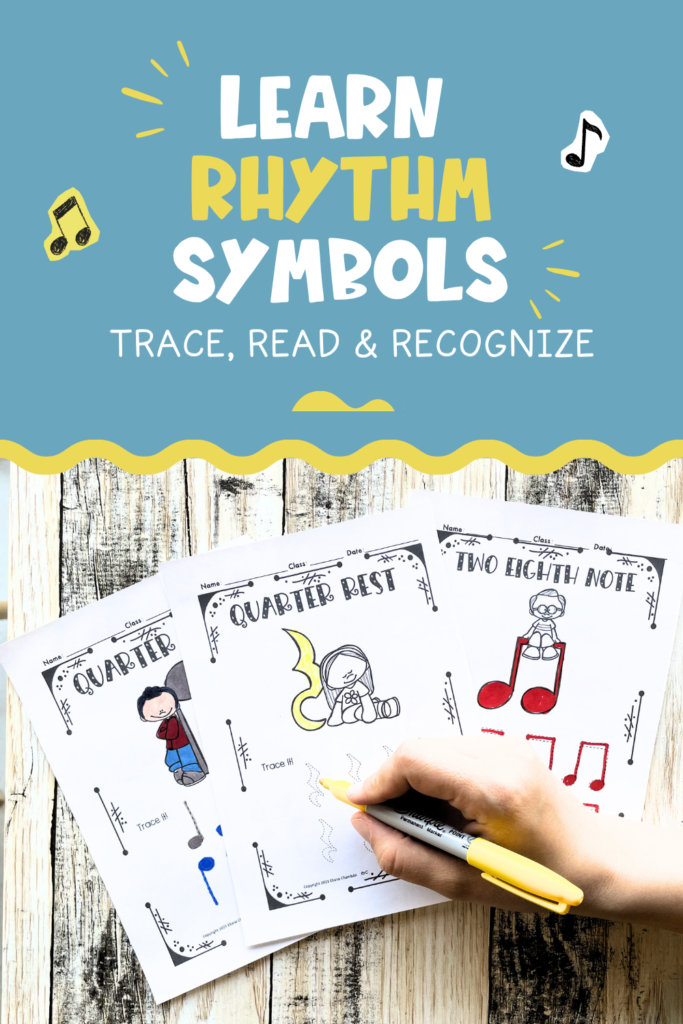
One activity I love using here is my Trace It Rhythm Notes Worksheets.
Although the complete resource includes additional rhythm values, I only print the pages that match what my students are currently learning.
Students trace each symbol while saying its name aloud.
This simple activity strengthens visual recognition and gives students another opportunity to connect the written symbol with the sound they’ve already experienced.
🇺🇸 See the Trace It Rhythm Notes Worksheets.
🇪🇸 Descubre las Actividades de Trazar y Dibujar Figuras.
Why this works
Children don't learn through one explanation.
They learn through repeated experiences that present the same concept in different ways.
Tracing is simply another opportunity to interact with the rhythm symbols without adding unnecessary difficulty.
“Save this idea for later
🇺🇸 See the Trace It Rhythm Notes Worksheets.
🇪🇸 Descubre las Actividades de Trazar y Dibujar Figuras.
Step 3 – Let Students Become Little Composers
This is probably one of my favorite parts of the sequence.
Instead of only reading rhythms, students begin creating them.
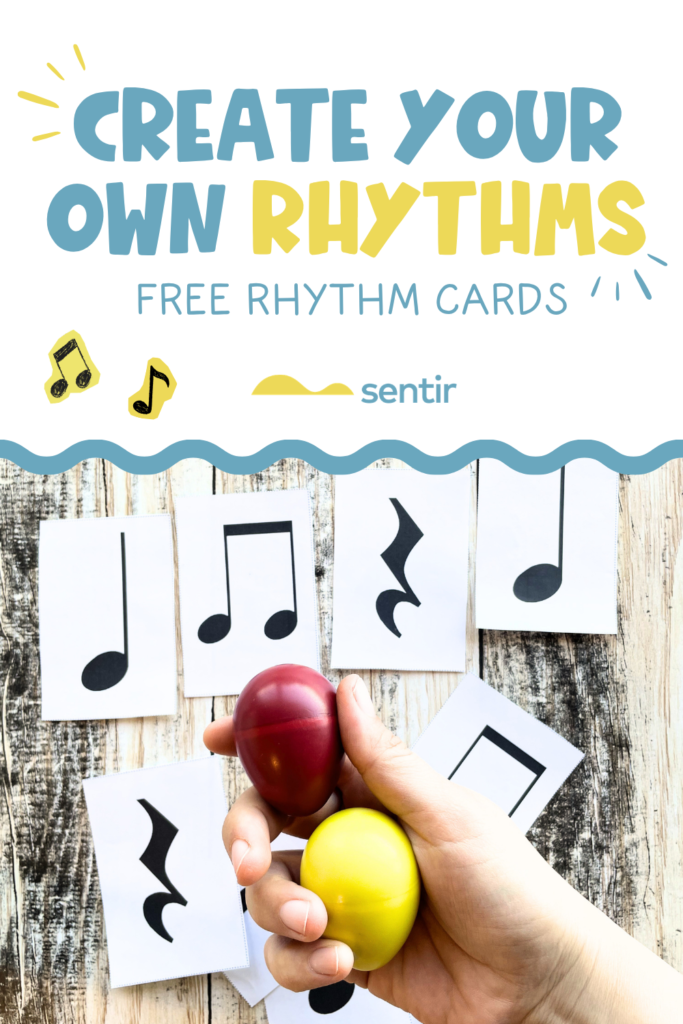
For this, I use my printable Rhythm Cards.
I originally designed these cards for beginner ukulele lessons, but they work beautifully in any elementary music classroom because they focus on the same rhythm symbols.
After laminating the cards, I give each student a small set of Quarter Notes, Beamed Eighth Notes, and Quarter Rests.
Students work individually, with a partner, or in small groups to build their own rhythm patterns.
Then we perform them together.
Sometimes we clap them.
Sometimes we play them on shakers.
Sometimes we use body percussion.
Sometimes students perform each other’s rhythms.
This is usually the activity students ask to repeat the most.
They love becoming composers.
🇺🇸 Download the FREE Printable Rhythm Cards
🇪🇸 Descarga GRATIS las Tarjetas de Ritmo Imprimibles
In My Classroom
If I could only keep one beginner rhythm resource, it would probably be these rhythm cards.
Students never seem to get tired of creating new rhythm combinations.
Every class creates something different.
“Save this idea for later
Step 4 – Reinforce Learning Through Practice
Once students have explored rhythm through movement and composition, I like giving them opportunities to organize what they’ve learned on paper.
This is where worksheets become valuable.
Not because worksheets teach rhythm by themselves, but because they reinforce concepts students have already experienced.
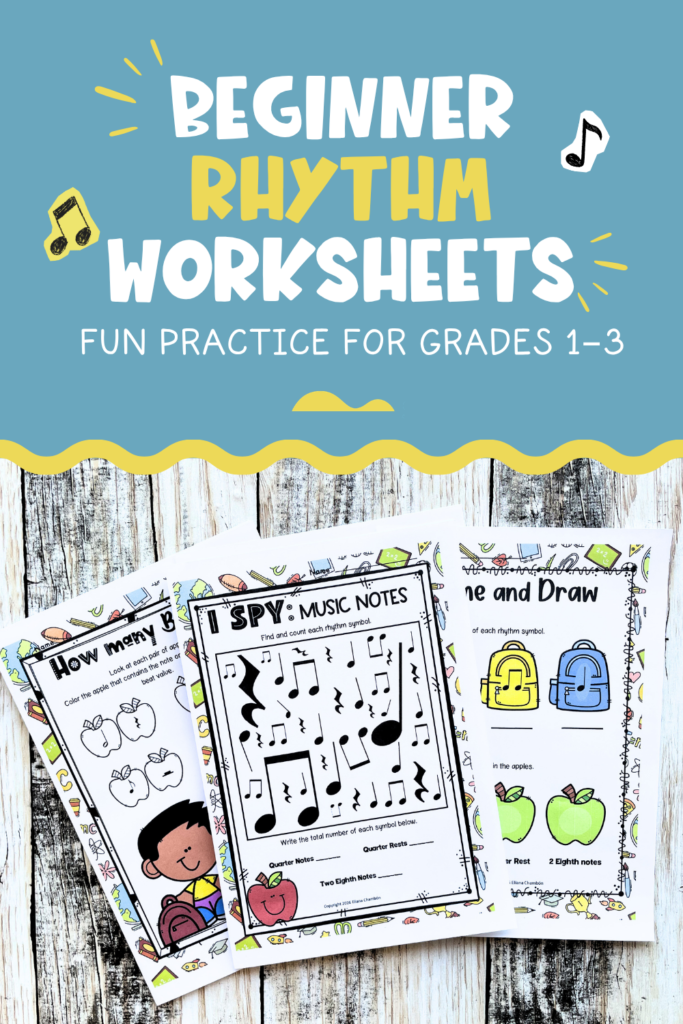
I often use activities like:
- rhythm matching
- identifying note values
- simple music math
- cut-and-paste rhythm building
- review worksheets
One of my favorite resources for this stage is my Back to School Rhythm Review Level 1, which focuses mainly on Quarter Notes, Beamed Eighth Notes, and Quarter Rests.
Rather than introducing new concepts, these worksheets help students feel successful with what they already know.
🇺🇸 Get the Back to School Rhythm Review Level 1
🇪🇸 Consigue las Hojas de Actividades de Repaso de Ritmo para la vuelta de Clase – Nivel 1
“Save this idea for later
🇺🇸 Get the Back to School Rhythm Review Level 1
🇪🇸 Consigue las Hojas de Actividades de Repaso de Ritmo para la vuelta de Clase – Nivel 1
Step 5 – Slow Things Down with Independent Practice
Not every activity has to be energetic.
After movement, games, and group work, I often like ending with something calmer.
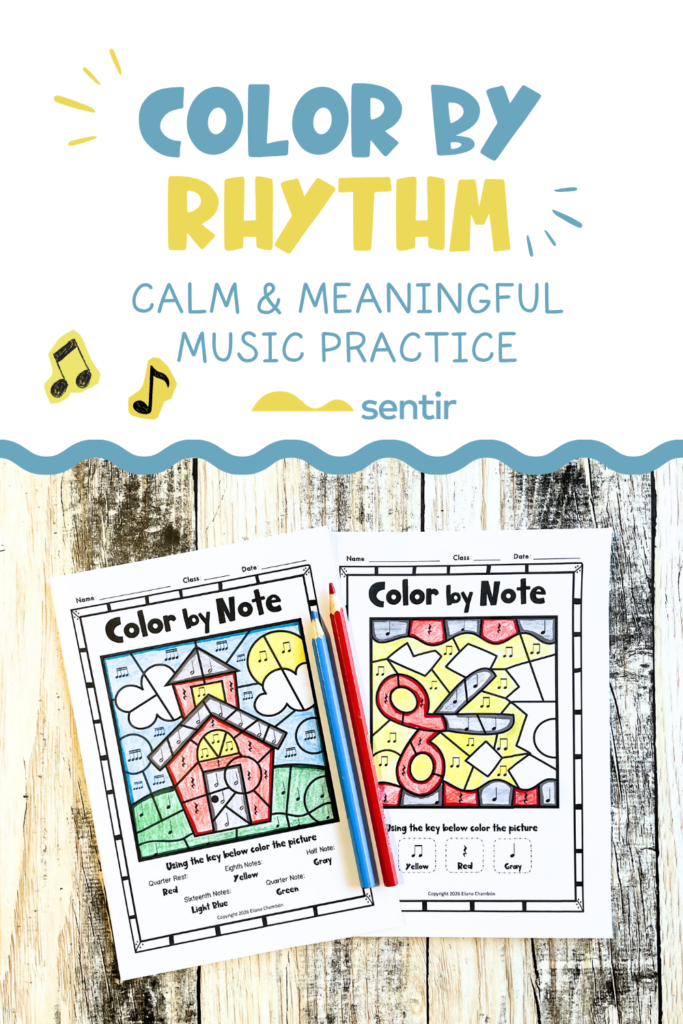
That’s where Color by Rhythm and Color by Music Math fit perfectly.
Some students absolutely love coloring.
Others prefer games.
That’s completely normal.
Every child learns differently.
Providing different types of activities allows every student to find a way to engage with the same musical concept.
Coloring activities also work wonderfully for:
- early finishers
- music centers
- substitute plans
- quiet classroom transitions
One thing I’ve noticed is that these activities help students slow down and really pay attention to each rhythm symbol.
🇺🇸 Explore the Color by Rhythm Worksheets.
🇪🇸 Explora las Actividades de Colorear por Figuras.
🇺🇸 Get the Color by Music Math Worksheets.
🇪🇸 Consigue las Actividades de Colorear por Matemáticas Musicales.
Teacher Tip
When a student finishes early, I almost always offer an independent coloring activity.
It keeps them engaged while allowing me to support other students who may need additional help.
“Save this idea for later
Step 6 – Review Everything Through Play
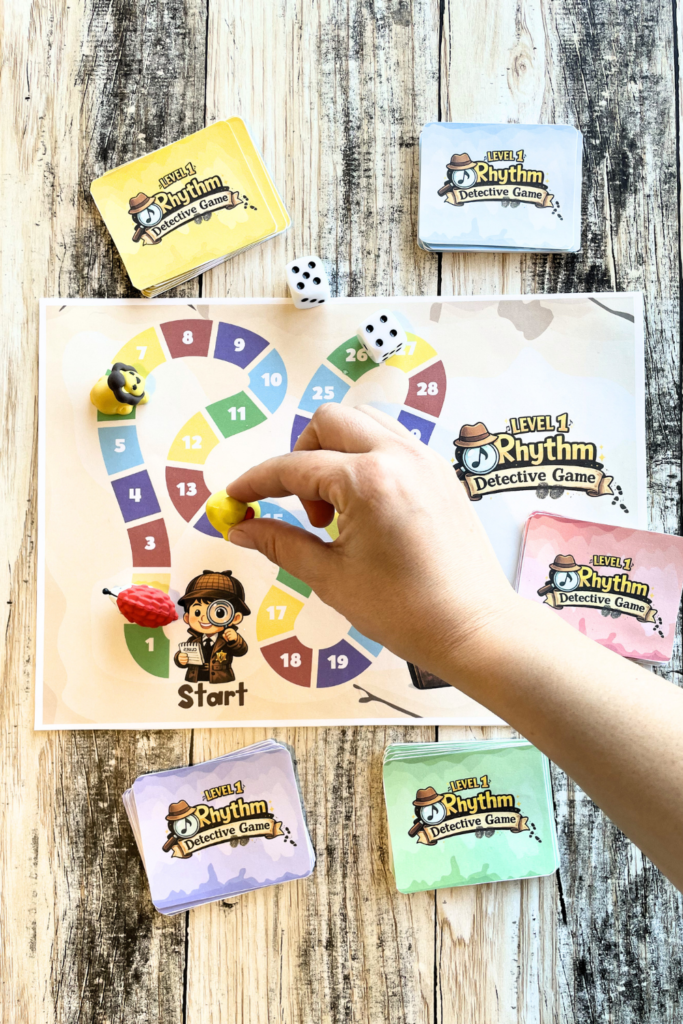
Only after students have experienced rhythm, recognized the notation, created their own patterns, and practiced independently do I introduce Rhythm Detective.
I intentionally designed this game as a review activity.
I wanted one resource that combined everything we had been practicing.
Students don’t just identify rhythm symbols.
They also:
- read rhythms
- compose simple patterns
- recognize note values
- apply everything they’ve learned through play
Because students already feel confident with the basic concepts, the game becomes a celebration of learning rather than another assessment.
 Try the Rhythm Detective Game
 Prueba el Juego “Detective del Ritmo”
In My Classroom
My students almost never struggle with Quarter Rests.
They actually enjoy saying "shh!"
Beamed Eighth Notes usually take a little more practice.
Many children initially want to say "ti-ti" for each individual note instead of the pair.
That's completely normal, and repeated movement activities usually solve the problem naturally.
Rhythm Is Something We Build All Year
One thing I want teachers to remember is that rhythm isn’t something we teach once and then move on from.
In my classroom, we continue revisiting these same concepts throughout the entire school year.
Every new activity strengthens something students already know.
That repetition is what builds confidence.
Rather than asking, “Have my students finished learning Quarter Notes?”, I prefer asking,
“How can I give them one more meaningful musical experience with Quarter Notes today?”
That simple change in mindset has completely transformed the way I teach rhythm.
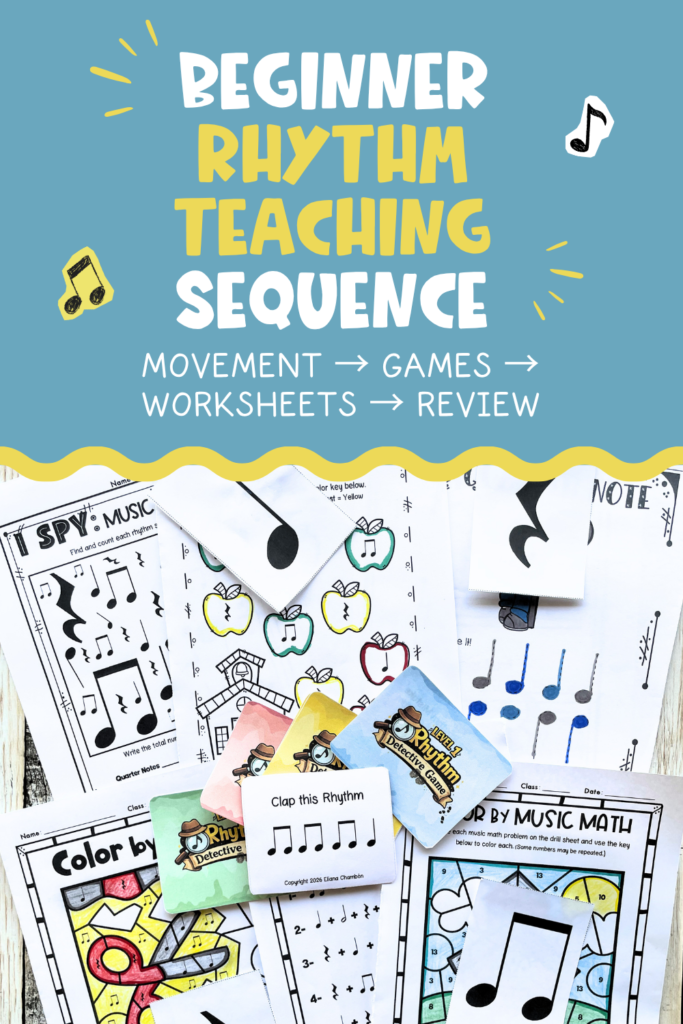
Beginner Rhythm Teaching Sequence
| Step | Focus | Suggested Activity |
|---|---|---|
| 1 | Experience rhythm | Songs, chants, movement |
| 2 | Recognize symbols | Trace It Rhythm Notes |
| 3 | Build rhythms | Free Rhythm Cards |
| 4 | Reinforce learning | Worksheets & Music Math |
| 5 | Independent practice | Color by Rhythm |
| 6 | Review | Rhythm Detective |
“Save this idea for later
🇺🇸 Explore the Complete Beginner Rhythm Activities Bundle
🇪🇸 Explora el Paquete Completo de Actividades de Ritmo para Iniciantes
Ready-to-Use Beginner Rhythm Resources
If you’re looking for classroom-tested activities that follow this same teaching sequence, here are the resources I use throughout the year:
| Resource | Best Used For |
|---|---|
| Trace It Rhythm Notes | Introducing rhythm symbols |
| Free Rhythm Cards | Rhythm composition and reading |
| Back to School Rhythm Review | Reinforcing note recognition |
| Color by Rhythm | Independent review |
| Color by Music Math | Practicing note values |
| Rhythm Detective | Whole-class review game |
| Beginner Rhythm Activities Bundle | Complete teaching sequence |
These activities are designed to work together while helping students gradually build rhythm confidence through movement, creativity, games, and meaningful practice.
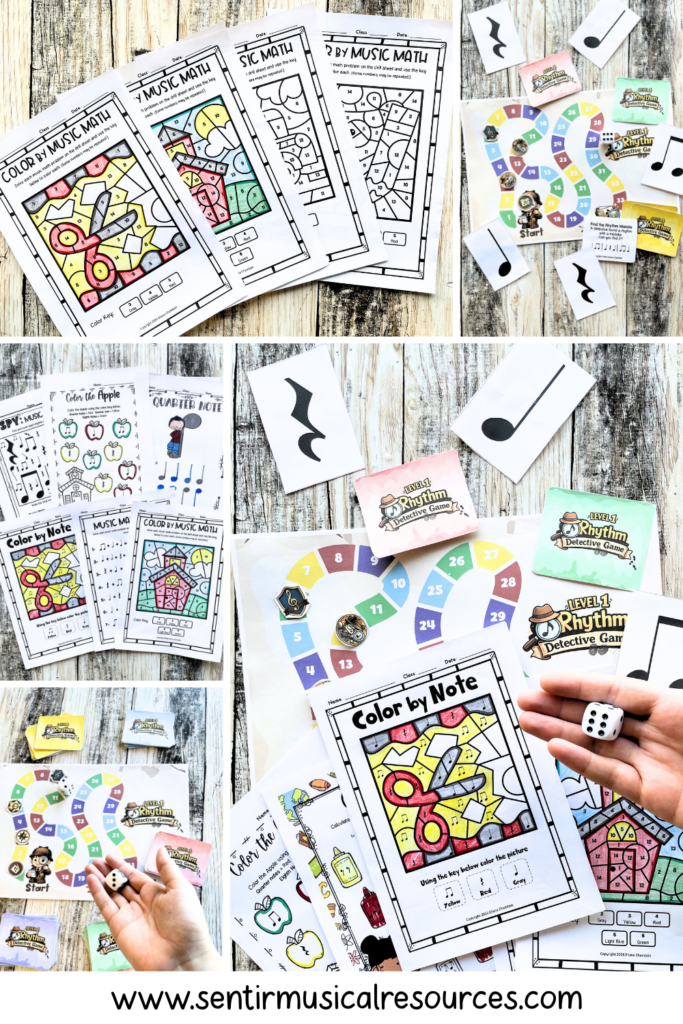
If you’d like to save planning time, I’ve gathered all of these activities into my Beginner Rhythm Activities Bundle. It includes printable games, worksheets, music math activities, review pages, and hands-on resources that work together to help students confidently learn quarter notes, beamed eighth notes, and quarter rests in Grades 1–3.
🇺🇸 Explore the Complete Beginner Rhythm Activities Bundle
🇪🇸 Explora el Paquete Completo de Actividades de Ritmo para Iniciantes
Frequently Asked Questions
What rhythm notes should I teach first in elementary music?
I recommend starting with Quarter Notes, Beamed Eighth Notes, and Quarter Rests. These rhythm values are easier for young learners to internalize through movement, games, and repetition before introducing longer or more complex note values.
Should I teach rhythm notation before movement activities?
In my classroom, I do the opposite. I introduce rhythm through listening, movement, chanting, and imitation first. Once students can confidently perform simple rhythm patterns, introducing notation becomes much more meaningful.
How long should students practice beginner rhythm?
Rather than teaching rhythm as a short unit, I revisit the same concepts throughout the school year. Repetition in different contexts helps students build confidence and long-term understanding.
What are the best activities for teaching beginner rhythm?
I like combining different types of activities, including:
- movement games
- rhythm cards
- printable worksheets
- coloring activities
- music math
- rhythm review games
Using a variety of activities helps reach different learning styles.
What if my students finish early?
Independent activities such as Color by Rhythm or Color by Music Math work well as extension tasks while other students finish the main activity.
Do I need classroom instruments to teach rhythm?
No. Many beginner rhythm activities can be done using body percussion, clapping, chanting, or simple classroom instruments like shakers.
Continue Exploring Elementary Music Teaching Ideas
If you enjoyed this article, you may also like:
 5 Fun Resources to Teach Piano Keys to Kids Perfect if you’re introducing beginner piano concepts in elementary music.
 How to Teach Ukulele Strumming: Games, Activities, and Lesson Ideas Discover simple ways to introduce strumming patterns through games and hands-on activities.
 Ukulele Strumming Pattern Game Looking for an engaging review activity? This printable game helps students practice beginner strumming patterns while having fun.
 Ukulele Chord Teaching Resources Explore beginner-friendly activities for teaching ukulele chords with confidence.
How to Teach Music Theory in a Way Students Actually Understand
Final Thoughts
Every music classroom is different.
Every group of students learns at its own pace.
The sequence I shared in this article isn’t the only way to teach rhythm, but it has helped my students build confidence, enjoy music-making, and develop strong rhythmic foundations year after year.
I hope these ideas inspire you to create joyful musical experiences in your own classroom.
Happy teaching!